Quick verdict
- ABS — easy to mold, easy to paint, cheap. Default for indoor consumer enclosures, toys, automotive interiors.
- PC (polycarbonate) — strongest of the three, transparent, impact-resistant. Default for safety equipment, optical lenses, lighting fixtures.
- PC+ABS blend — best of both. PC’s strength + ABS’s processability. Default for laptop housings, automotive dashboards, premium consumer electronics.
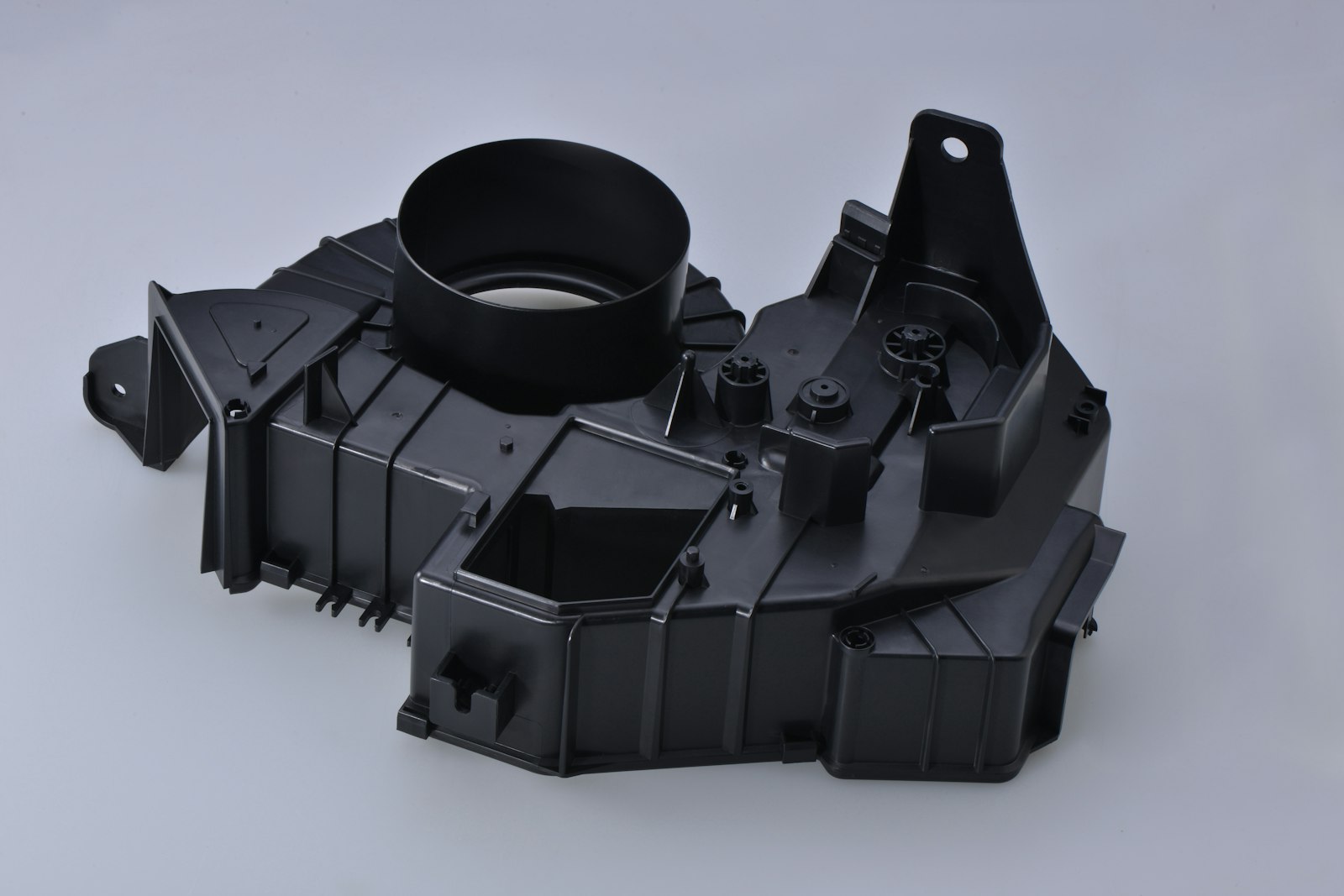
The right pick is almost always one of these three for any general-purpose plastic part. This guide explains the why.
Chemistry primer (60 seconds)
ABS (Acrylonitrile Butadiene Styrene) is a terpolymer — three monomers chemically bonded. The acrylonitrile gives it heat resistance, butadiene gives toughness, styrene gives gloss and rigidity. The resulting plastic is opaque, tough and easy to dye in any color.
PC (Polycarbonate) is a single high-molecular-weight polymer chain. It’s naturally transparent (~92% light transmission), exceptionally impact-resistant (250× the impact strength of glass), and stable over a wide temperature range. The trade-off is it scratches easily and dissolves in solvents that ABS shrugs off.
PC+ABS is a physical blend — typically 30-70% PC, 30-70% ABS — engineered to combine PC’s mechanical strength with ABS’s processability and surface finish. Common ratios are PC60/ABS40 for premium applications, PC40/ABS60 for cost-sensitive ones.
Mechanical properties side-by-side

| Property | ABS | PC | PC+ABS |
|---|---|---|---|
| Tensile strength (MPa) | 40-50 | 60-70 | 50-65 |
| Yield strength (MPa) | 35-50 | 55-65 | 45-60 |
| Flexural modulus (MPa) | 2,000-2,500 | 2,300-2,400 | 2,200-2,400 |
| Notched Izod impact (J/m) | 200-400 | 600-900 | 400-800 |
| Heat deflection (°C, 1.82 MPa) | 80-105 | 130-140 | 100-125 |
| Continuous service temp (°C) | 70-90 | 100-130 | 85-110 |
| Density (g/cm³) | 1.04-1.06 | 1.20 | 1.10-1.15 |
Reading the table: PC is roughly 50% stronger and 2× tougher (impact) than ABS. PC+ABS sits in the middle on every dimension — closer to PC on impact and heat, closer to ABS on flow and finish.
Injection-molding processability
How does each material actually behave on the press?
| Aspect | ABS | PC | PC+ABS |
|---|---|---|---|
| Melt temperature (°C) | 220-260 | 280-320 | 240-290 |
| Mold temperature (°C) | 40-80 | 80-120 | 60-100 |
| Drying required | Light (2-4 hr at 80°C) | Critical (3-4 hr at 120°C) | Yes (3-4 hr at 100°C) |
| Flow length (mm/mm wall) | 200-300 | 100-200 | 150-250 |
| Shrinkage (%) | 0.4-0.7 | 0.5-0.7 | 0.5-0.7 |
| Cycle time vs ABS baseline | 1.0× | 1.4-1.6× | 1.1-1.3× |
ABS is the easy one. Lower temperatures, faster cycles, forgiving of moisture, fills long thin sections without skinning. PC is the hard one — must be dried thoroughly (residual moisture causes brittleness on demold), needs a hot mold to avoid stress cracks, takes 50% longer per cycle. PC+ABS mostly behaves like ABS with slightly tighter requirements — a sweet spot for production.
For typical part complexity (housings, brackets, cosmetic shells), the per-piece cost ratio holds:
ABS = 1.0× · PC+ABS = 1.3× · PC = 1.8-2.0×
Surface finishing and decoration
How does the finished surface look and how does it accept decoration?

- ABS: matte to medium-gloss native finish, easy to dye in molding (full color spectrum), excellent for paint (any standard automotive paint adheres without primer), accepts hot-stamping and pad printing. Acetone-vapor smoothing produces a glossy finish — though brittle afterward.
- PC: native glassy clear, very high gloss when polished, but prone to scratching. Paints need primer or surface activation to adhere. Stress crazing under solvent exposure is a real risk — solvent-based paints can damage the substrate.
- PC+ABS: medium-high gloss, paints like ABS (no primer needed), takes hot stamping and laser-marking cleanly. The PC content slightly improves scratch resistance over pure ABS.
Practical implication: if your part will be painted (e.g. automotive trim, consumer electronics), PC+ABS is the best painted-part substrate of the three. ABS is the cheapest. Pure PC is reserved for transparent or unpainted parts.
UV resistance and outdoor durability
This is where the three diverge sharply:
- ABS: poor UV resistance — yellows visibly within 6-12 months of direct sun. UV-stabilized grades are available but add 10-15% to material cost.
- PC: better than ABS but still degrades — yellowing and embrittlement in 1-3 years of outdoor exposure. UV-stabilized PC (with HALS additives) lasts 5-10+ years.
- PC+ABS: similar to ABS for UV — poor without stabilizers. Designed for indoor use.
For outdoor applications, switch to ASA (similar to ABS but UV-stable) or specify UV-stabilized PC. Don’t use unstabilized ABS or PC+ABS outdoors.
Cost in production
| Quantity | ABS (USD/kg) | PC (USD/kg) | PC+ABS (USD/kg) |
|---|---|---|---|
| Standard grade (commodity) | $1.80-2.40 | $3.20-4.00 | $2.40-3.20 |
| Glass-filled grade (+30% GF) | $2.50-3.20 | $4.50-5.50 | $3.20-4.20 |
| UV-stabilized | $2.20-2.80 | $4.00-5.00 | $2.80-3.50 |
| Flame-retardant (V0) | $2.80-3.50 | $5.00-6.50 | $3.20-4.20 |
Material cost vs total part cost: for a typical 100-gram molded part, raw material is 30-50% of the total per-piece cost. The cycle-time difference (PC takes 50% longer) often dwarfs the resin cost gap — a PC part can cost 1.8-2.0× total even though resin cost is “only” 1.5-2× ABS.
Six typical applications and the right choice
1. Indoor consumer electronics housing (router, cable modem): ABS. Cheap, paintable, 70°C continuous service is plenty. 2. Laptop / tablet body: PC+ABS. Strong, paintable, drops survive better than ABS, processes faster than pure PC. 3. Automotive interior trim (dashboard, console): PC+ABS or ABS. PC+ABS for premium vehicles, ABS for budget. Both painted. 4. Safety glasses, face shields, optical equipment: PC. Transparency, optical clarity, impact resistance. No alternative. 5. Lighting fixture diffusers, machine guards: PC. Transparency + impact + 130°C service. 6. Children’s toys with paint or graphics: ABS. Best paint adhesion, low cost, food-safe grades available.
Glass-fiber reinforcement: when to add it
Pure ABS, PC and PC+ABS are versatile but not the strongest options for structural parts. Glass-filled grades (typically 20% or 30% short fiber) add stiffness, strength and dimensional stability:
| With 30% glass fiber | Tensile strength gain | Stiffness gain | Trade-off |
|---|---|---|---|
| ABS+30GF | +60% (~70 MPa) | +180% | Brittle, lower impact |
| PC+30GF | +30% (~85 MPa) | +220% | Loses transparency |
| PC+ABS+30GF | +50% (~85 MPa) | +200% | Surface finish suffers |
For load-bearing structural parts where stiffness matters more than appearance, glass-filled PC or PC+ABS replaces aluminum brackets in many designs at lower cost and weight.
Decision flowchart
Walk through these in order — first match wins:
- Need transparency? → PC.
- Outdoor / UV exposure? → UV-stabilized PC, or switch to ASA.
- Service temp > 100°C? → PC.
- Premium painted finish or laptop-class drop survival? → PC+ABS.
- Cosmetic part for indoor use, painted or dyed, < 90°C? → ABS.
- Need maximum stiffness for a structural bracket? → 30%-glass PC or PC+ABS.
For anything that doesn’t fit cleanly into one of those — combination of high strength, high temperature, food contact, medical biocompatibility — look beyond these three at PEI, PEEK, or specialty engineering plastics. See the broader materials library for those.
FAQ
Can I use ABS where the spec calls for PC+ABS?
Sometimes — if the loading and temperature are well below the PC+ABS spec, ABS may work. But PC+ABS is usually specified specifically for impact resistance or service temp, and ABS will fail those requirements. Don’t substitute without re-validating against the actual use case (drop test, temperature soak).
Why do laptop manufacturers use PC+ABS instead of pure PC?
Three reasons: (1) cycle time — PC takes 50% longer to mold per part, eating into production capacity. (2) paint adhesion — pure PC requires surface treatment before painting. (3) cost — pure PC is 30-40% more expensive per kilogram. PC+ABS captures 80% of PC’s mechanical properties at 60-70% of the cost.
How do I tell ABS, PC, and PC+ABS apart visually?
Pure PC is transparent (clear). ABS and PC+ABS are opaque and look identical to the eye in finished parts. The recycling number stamped on bottom (resin identification code 7 with “ABS”, “PC” or “PC/ABS” written) is the only reliable visual indicator. Lab testing — FTIR or differential scanning calorimetry — is the definitive way.
Is PC+ABS food-safe?
Some grades are FDA-approved for food contact (typically the unfilled, non-pigmented base resins). However, color masterbatches and UV stabilizers may not be food-safe — verify the specific grade and additive package against your application before use. ABS has more FDA-approved grades available than PC+ABS or PC.
What about recycling?
ABS is widely recyclable (resin code 7-ABS), and recycled ABS is a viable spec for non-cosmetic parts at ~70% the cost of virgin. PC recycles less commonly because manufacturing consistency is harder to maintain. PC+ABS is rarely recycled into the same blend due to compatibility issues. For sustainability-conscious applications, recycled ABS is a meaningful lever; PC and PC+ABS are not.
Get a quote in 24 hours
Send your STEP / DWG file — engineer-direct reply with DFM included.
Leave a Reply