
Quick verdict
Design for Additive Manufacturing (DfAM) is the practice of redesigning a part to take advantage of what 3D printing can do — and what subtractive manufacturing cannot. The three pillars:
- Lattice infill — replace solid material with internal lattice structures, cutting weight 30-60% with minimal strength loss.
- Topology optimization — let software remove material along non-loaded paths, producing organic shapes that beat human-designed brackets on stiffness-per-gram.
- Part consolidation — collapse 5-15 separately-machined parts into a single 3D-printed part, eliminating fasteners and assembly time.
Designing for AM is fundamentally different from designing for CNC. This guide walks through what changes and how to actually do it.
Why DfAM matters
A “3D printable” part is rarely a “well-designed-for-3D-printing” part. Take a CNC bracket, send it to a metal 3D printer, and you get a heavier, more expensive, higher-cycle-time version of the same bracket. The geometry was constrained by what a CNC cutter can reach — straight walls, simple pockets, draft-friendly slopes.
A DfAM-redesigned bracket might:
- Use 30% less material (topology-optimized organic shape)
- Weigh 50% less (internal lattice replaces solid sections)
- Have integrated mounting bosses, cable channels, and cooling features (no separate parts to assemble)
- Cost 40% less to print (less material, less build time)
The same hardware function delivered with significantly better performance metrics — but only if you redesign with AM in mind from the start.
Lattice structures explained
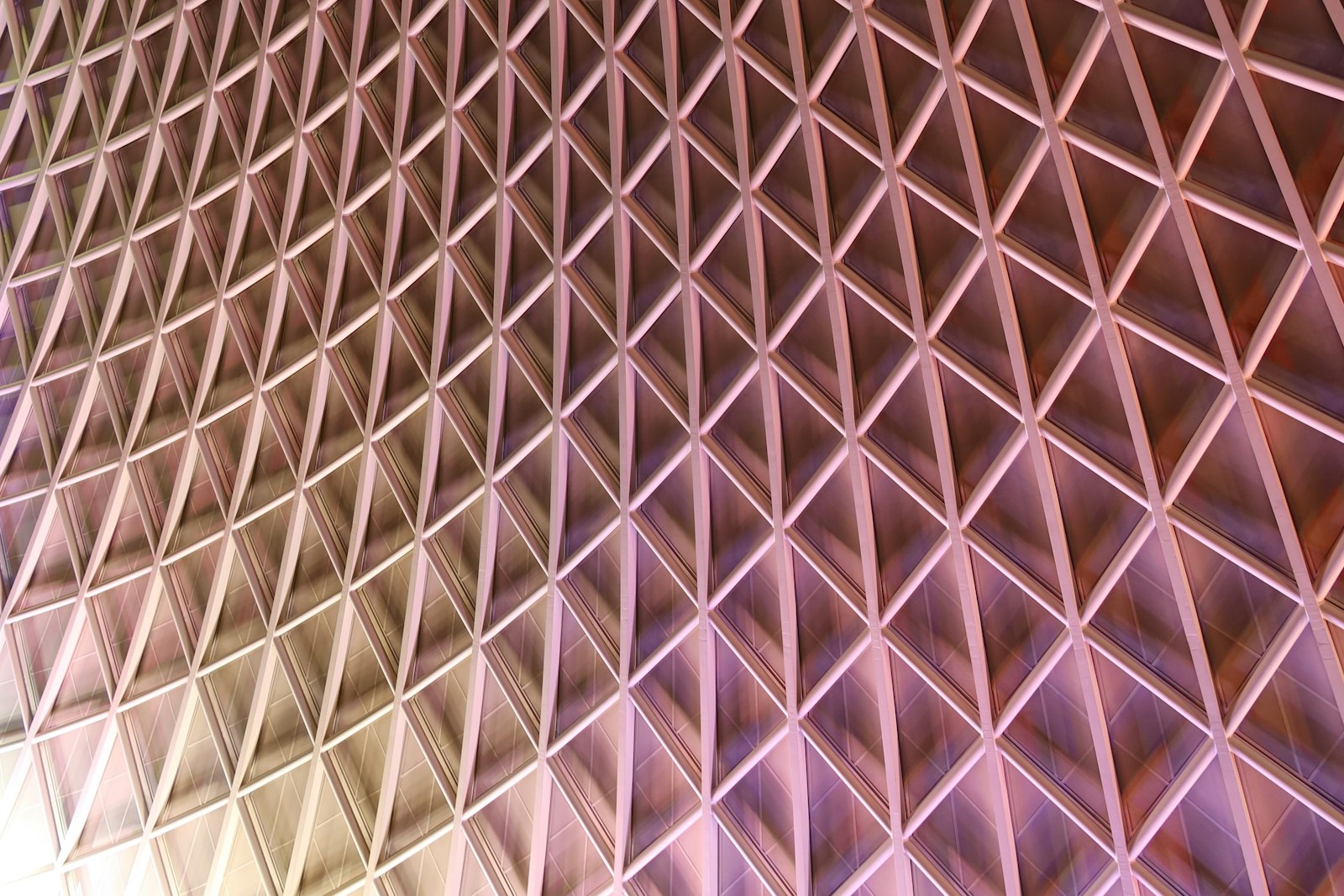
A lattice replaces solid material with a repeating geometric pattern of struts and connections. The volume fraction (how much material vs empty space) controls the strength-weight tradeoff.
Common lattice types
| Lattice type | Strength behavior | Best for |
|---|---|---|
| Cubic / strut-based | Anisotropic — strong along strut axes | Compression along known load direction |
| Octet truss | Isotropic — equal strength all directions | Uniform multi-axis loading |
| Gyroid (TPMS) | Smooth, no sharp transitions | High strength-to-weight, fluid passages |
| Schwarz P / D (TPMS) | Smooth surfaces | Heat exchange, biomedical scaffolds |
| Voronoi | Quasi-random, organic | Cosmetic / artistic applications |
| FCC / BCC variants | Borrowed from crystallography | Specific performance profiles |
TPMS (Triply Periodic Minimal Surfaces) like Gyroid have become the standard for engineering applications because they have no sharp stress concentrations — every transition is curved, distributing load smoothly. Aerospace and medical applications increasingly default to Gyroid lattices for cleanest performance.
Lattice volume fraction and strength
A 30% volume fraction (i.e. 70% empty space) typically retains 60-70% of solid material’s compressive strength while using 30% of the mass. The relationship isn’t linear — small volume fractions disproportionately lose strength, while large fractions disproportionately add weight without much strength gain. The sweet spot for most engineering applications is 20-40% volume fraction.
Where lattice structures fail
Lattices are NOT universal. They fail badly in:
- Tension across the lattice direction (struts pull apart)
- Concentrated point loads (no solid material to spread the load)
- Thin-walled regions (struts become buckling-prone at small scales)
- Fatigue-critical applications (every strut joint is a stress concentration)
Use lattice for compression and bending in known load directions, not as a universal solid replacement. For point loads (bolt holes, mounting bosses), surround the lattice with solid material 5-10 mm thick.
Topology optimization workflow
Topology optimization is the algorithmic counterpart to lattice infill. Software starts with a “design domain” (the maximum envelope your part can occupy) and iteratively removes material from low-stress regions until only the load-bearing skeleton remains.

The 5-step workflow
1. Define design domain — bounding volume the part can occupy 2. Define load cases — forces, torques, pressures applied at specific locations 3. Define constraints — fixed mounting points, no-go zones, manufacturing limits 4. Set optimization target — typically “minimize mass at constant stiffness” or “maximize stiffness at constant mass” 5. Run iterations — software removes 1-5% of mass per iteration until the constraint is hit
Modern topology optimization runs in 30 minutes to 2 hours on a standard workstation. The output is a mesh that captures the optimal load path — usually organic, branching, biological-looking forms that no human engineer would draw freehand.
Software tools
| Tool | Best for | Cost |
|---|---|---|
| nTopology / nTop | Industrial, lattice + topology combined | $$$ (subscription) |
| Altair Inspire | Standalone topology optimization | $$ |
| Autodesk Fusion 360 Generative Design | Hobbyist to mid-market | $ (Fusion sub) |
| Ansys Discovery | Linked with full FEA | $$$ |
| SolidWorks Topology Study | Within SolidWorks ecosystem | Bundled |
| Tosca / Abaqus | Enterprise / aerospace | $$$$ |
The cheapest practical entry point is Fusion 360’s Generative Design — included in any Fusion subscription, produces good results for general engineering parts. Most aerospace and defense work uses nTop or Tosca for the production-grade controls.
Part consolidation: the secret DfAM win
The biggest wins from DfAM often aren’t lattice or topology — they’re collapsing assemblies into single parts.
A typical aerospace bracket might have:
- Main body (CNC machined)
- 4 mounting plates (sheet metal stamped + welded)
- 6 PEM nuts (press-installed)
- 4 corner brackets (CNC + bonded)
- Total: 15 parts, 12 fasteners, 4 weld operations, ~3 hour assembly time
A DfAM-redesigned version is one printed piece. The mounting plates are integral. The cable channels are internal pockets. The PEM-nut threads are direct printed (or post-tapped). 0 fasteners, 0 welds, 0 assembly.
The same function with 70% fewer parts, 0 supply chain failure points, and 3 hours of assembly labor eliminated. Even at higher per-piece print cost, the total system cost drops dramatically.
GE’s famous LEAP fuel nozzle is the canonical example: 20 parts collapsed into 1, weight reduced by 25%, durability increased 5×.
Process constraints — what AM still can’t do
DfAM doesn’t mean “anything goes”. Real 3D printers have real limits:
| Constraint | Polymer (SLA/SLS/MJF) | Metal (DMLS) |
|---|---|---|
| Min wall thickness | 0.5-0.7 mm | 0.4-0.5 mm |
| Min hole / pocket | 0.4-0.5 mm | 0.4-0.6 mm |
| Min strut diameter (lattice) | 0.5 mm | 0.5 mm |
| Max overhang angle (no support) | 45° | 45° |
| Surface finish (Ra) | 6-15 µm | 5-15 µm |
| Build orientation | Affects strength + finish | Critical for fatigue |
| Internal cavities | OK if powder can escape | OK if powder can escape |
| Print + post-processing time | 1-3 days | 4-7 days |
The 45° overhang rule is the most common constraint. Surfaces that face downward at less than 45° need support structures during printing — supports are wasteful, leave surface marks, and add cleanup time. DfAM-aware design avoids 0-45° downward surfaces by orienting the part well or adding self-supporting features.
Real lightweighting cases
Drone gimbal mount (Ti-6Al-4V)
- Original CNC: 240 g
- DfAM with topology + lattice: 138 g
- Weight reduction: 42%, equivalent stiffness, 1.6× cost
Bicycle stem bracket (AlSi10Mg)
- Original CNC milled: 175 g
- DfAM topology-optimized: 92 g
- Weight reduction: 47%, +12% stiffness from organic shape
Robot end-effector (PA-CF nylon)
- Original assembled (3 parts): 45 g + 12 g + 8 g = 65 g
- DfAM consolidated single part: 38 g
- Weight reduction: 42% AND eliminated 6 fasteners
Aerospace cabin bracket (CoCrMo)
- Original CNC: 510 g
- DfAM with TPMS lattice infill: 245 g
- Weight reduction: 52%, 25% improved stiffness, single-piece replaces 3-part assembly
For full case studies and production photos, see our customer case studies.
A practical DfAM checklist
Before redesigning a part for additive manufacturing:
- Identify load cases — where do forces actually apply?
- Mark fixed regions — bolt holes, mating surfaces, no-go zones
- Define design envelope — bounding box for topology to work within
- Pick lattice strategy if applicable (compressive load → simple lattice; bending → topology with shells)
- Verify min wall / strut dimensions match printer capability
- Plan part orientation for build direction
- Add powder-removal channels for trapped cavities
- Define solid regions around bolt holes (lattice doesn’t take point loads)
- Validate with FEA before printing
- Plan post-processing (HIP, surface finish, machining of critical features)
The DfAM redesign typically takes 1-3 weeks for a typical aerospace bracket. The payoff — weight saved, parts consolidated, assembly time eliminated — usually justifies the engineering effort by the second production lot.
FAQ
Can I just convert any CNC part to a 3D-printed part?
You can print any CNC part — but you won’t get DfAM benefits. To get the cost / weight wins, you need to redesign. As a rule of thumb: a “literal conversion” of CNC geometry to 3D print is 1.5-3× the CNC cost with no functional improvement. A real DfAM redesign delivers 30-50% weight reduction and competitive cost.
How much does topology optimization software cost?
Free tier: Fusion 360 Generative Design (included in Fusion subscription, ~$700/year). Mid-market: Altair Inspire (~$5K/seat/year), nTop ($10-15K/seat/year). Enterprise: Tosca, Ansys Discovery ($20K+/seat). For one-off projects, our engineering team includes topology runs as part of 3D printing service — you don’t need to invest in software.
Are 3D-printed parts weaker than CNC?
Not necessarily — DMLS metal parts can match or exceed wrought equivalents after HIP treatment. SLS/MJF nylon parts have isotropic strength close to injection-molded equivalents. SLA resin parts ARE weaker than injection-molded thermoplastic. The “additive vs subtractive strength” debate depends entirely on the specific process, material and post-processing — not a universal rule. See SLA vs SLS vs MJF for polymer specifics, DMLS vs CNC for metal.
What’s the typical weight reduction from DfAM?
For aerospace, motorsport and medical brackets: 30-50% weight reduction is standard with no functional sacrifice. For consumer products with simple loading: 10-20% (the design wasn’t oversized to begin with). For tooling and fixtures with conformal cooling: weight isn’t the goal but cycle time improves 30%+. The right metric depends on the application — don’t optimize for weight if cost / cycle time matters more.
How long does a DfAM redesign take?
Simple bracket / housing: 3-7 days for an experienced engineer. Complex multi-part consolidation: 2-4 weeks including FEA validation. For production-grade aerospace work with regulatory documentation: 4-8 weeks. The redesign work pays back through reduced material cost and assembly time, typically by the 2nd-5th production batch.
Get a quote in 24 hours
Send your STEP / DWG file — engineer-direct reply with DFM included.

Leave a Reply