

Quick verdict
The single fastest way to cut your CNC quote in half is to stop over-specifying tolerances. Most engineering parts work perfectly at ±0.1 mm (the ISO 2768-medium default), yet half the drawings we receive call out ±0.025 mm or tighter on every dimension — sometimes 4× the necessary cost for no functional benefit.
This guide walks through ISO 2768, the cost multiplier per tolerance band, the actual fit relationships that justify tight tolerances, and the 7 over-spec mistakes that drive up cost without improving the part.
ISO 2768 in 90 seconds
ISO 2768 is the most common general-tolerance standard for machined parts. Instead of writing a tolerance on every dimension on the drawing, you put one block in the title block:

General tolerances ISO 2768-mK
That single callout sets defaults for every untoleranced dimension. Tolerances depend on dimension size:
| Dimension range | Fine (f) | Medium (m) | Coarse (c) | Very coarse (v) |
|---|---|---|---|---|
| 0.5-3 mm | ±0.05 | ±0.1 | ±0.2 | — |
| 3-6 mm | ±0.05 | ±0.1 | ±0.3 | ±0.5 |
| 6-30 mm | ±0.1 | ±0.2 | ±0.5 | ±1.0 |
| 30-120 mm | ±0.15 | ±0.3 | ±0.8 | ±1.5 |
| 120-400 mm | ±0.2 | ±0.5 | ±1.2 | ±2.5 |
| 400-1000 mm | ±0.3 | ±0.8 | ±2.0 | ±4.0 |
ISO 2768-medium (m) is the default for most machine shops worldwide — it’s free to achieve on modern CNC machines, holds for nearly all engineering applications, and aligns with what shops measure to anyway.
The “K” in “ISO 2768-mK” specifies geometric tolerance class K (medium) for things like flatness, perpendicularity, parallelism. Other classes are H (fine) and L (coarse). For most parts, mK is the right pick.
Practical rule: Put ISO 2768-mK in your title block. Apply explicit tighter tolerances ONLY to features that need them (bearing fits, sealing surfaces, indexing dimensions). Everything else inherits the standard.
Cost multiplier by tolerance band
Here’s what tolerance actually costs at our shop. Multiplier is relative to ISO 2768-medium baseline:
| Tolerance | Cost vs baseline | How achieved |
|---|---|---|
| ±0.5 mm (very coarse) | 0.7× | Single rough pass, no finish |
| ±0.2 mm (coarse) | 0.85× | Standard finish pass |
| ±0.1 mm (medium / ISO 2768-m) | 1.0× — default | Routine production |
| ±0.05 mm (fine) | 1.3× | Slow finish pass + comparator inspection |
| ±0.025 mm | 1.8× | Very slow finish + dial indicator setup |
| ±0.01 mm | 2.5× | Climate-controlled + CMM verification |
| ±0.005 mm | 4.0×+ | Grinding or jig-boring + lab inspection |
Reading the table: A part designed at ISO 2768-medium ($50/piece base) becomes:
- ±0.05 mm everywhere → $65/piece
- ±0.025 mm everywhere → $90/piece
- ±0.01 mm everywhere → $125/piece
- ±0.005 mm everywhere → $200+/piece
The same part with tight tolerance only on 2-3 critical features stays at $55-65. The decision is whether you specify globally or per-feature.
When tight tolerances are actually justified
Specific scenarios where ±0.025 mm or tighter is the right call:
| Application | Recommended tolerance | Why |
|---|---|---|
| Press-fit pin into hole | ±0.025 mm | Interference fit needs ≤ 0.05 mm range |
| Bearing seat (housing) | ±0.025 mm (H7 fit) | Bearing manufacturer specifies it |
| Sliding fit (piston-cylinder) | ±0.025 mm (H8/g7) | Loose enough to slide, tight enough to seal |
| Sealing surface (O-ring groove) | ±0.05 mm width, ±0.025 mm depth | Squeeze ratio matters |
| Optical mounts | ±0.01 mm | Sub-micron alignment requirements |
| Aerospace structural pin holes | ±0.005 mm | Fatigue safety margin |
| Hydraulic spool valve | ±0.005 mm | Leakage clearance |
| Gear hub-to-shaft fit | ±0.025 mm | Concentricity for smooth running |
| Decorative cover (cosmetic) | ±0.5 mm or ISO 2768-m | No functional fit |
If your dimension doesn’t appear in this list and isn’t part of a documented fit (H7, h6, etc.), default to ISO 2768-medium and save the budget for features that need it.
Fit relationships and standardized callouts
For shaft / hole fits, ISO 286 defines standard fit pairs that machinists know by code. Using these instead of explicit ± callouts is more compact AND more accurate:
| Fit type | Code | Example tolerance (Ø 25 mm) | Use case |
|---|---|---|---|
| Loose running | H11/c11 | Ø 25 +0.13/-0.16 / -0.11/-0.24 | Quick assembly, dirty environments |
| Free running | H9/d9 | Ø 25 +0.052/0 / -0.040/-0.092 | Bearings under load, generous lubrication |
| Close running | H7/g6 | Ø 25 +0.021/0 / -0.007/-0.020 | Sliding bearings, ball-bearing housings |
| Sliding fit | H7/h6 | Ø 25 +0.021/0 / 0/-0.013 | Light slip fit |
| Locational clearance | H7/k6 | Ø 25 +0.021/0 / +0.015/+0.002 | Light press fit, alignable |
| Press fit | H7/p6 | Ø 25 +0.021/0 / +0.035/+0.022 | Permanent assembly, no torque |
| Force fit | H7/u6 | Ø 25 +0.021/0 / +0.054/+0.041 | Permanent, transmits torque |
On the drawing, just write Ø 25 H7 for the housing or Ø 25 g6 for the shaft. Machinists translate those to numerical tolerances and pick the right finishing process.
Inspection cost — the hidden tolerance multiplier
Tighter tolerance doesn’t just affect machining — it adds inspection time:

| Inspection method | Tolerance verifiable | Time per dim. | Tooling cost |
|---|---|---|---|
| Steel rule | ±0.5 mm | 5 sec | $5 |
| Vernier caliper | ±0.05 mm | 15 sec | $50 |
| Digital caliper | ±0.02 mm | 10 sec | $80 |
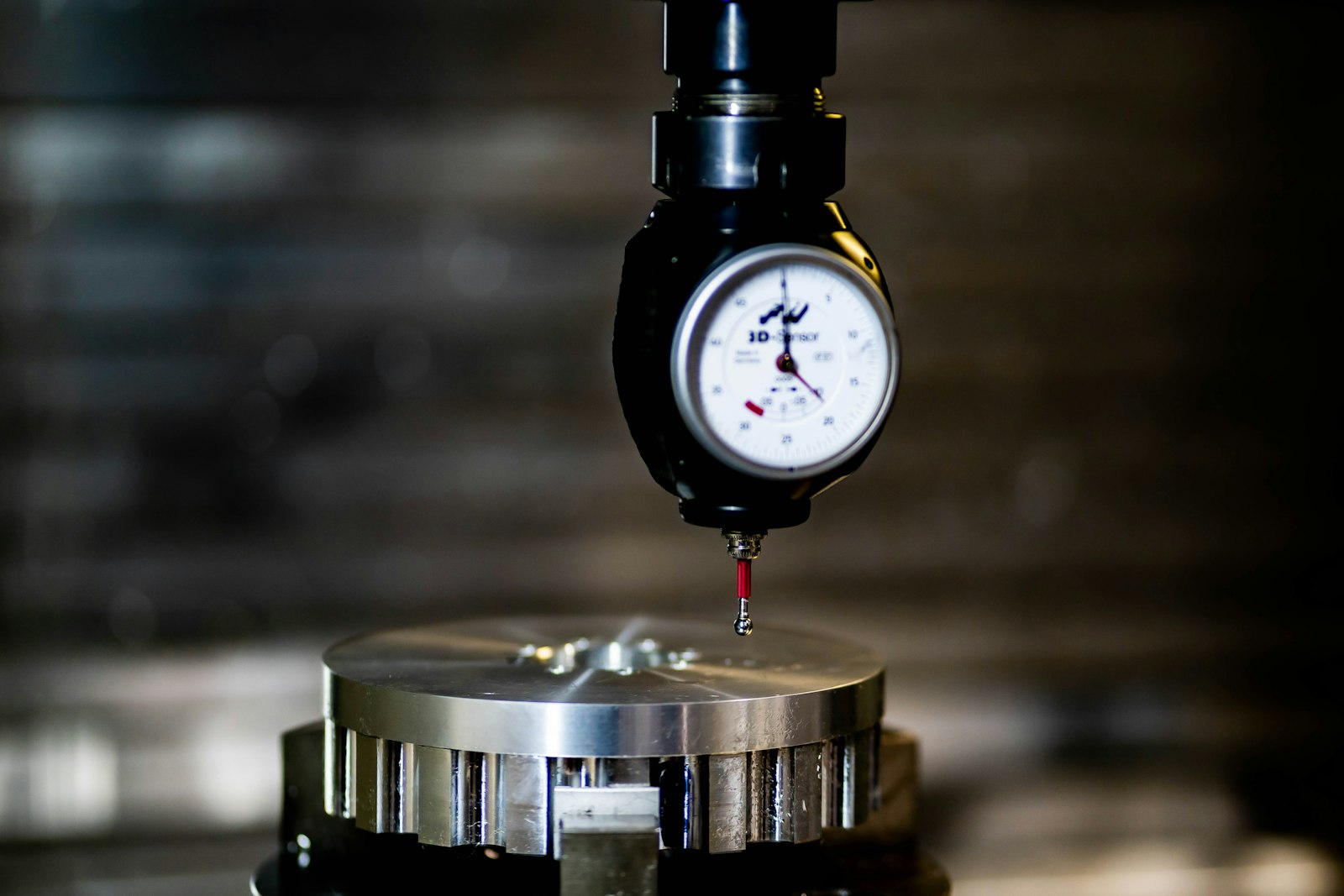
| Dial indicator + surface plate | ±0.01 mm | 30-60 sec | $200 |
| Gauge blocks + comparator | ±0.005 mm | 60-120 sec | $400-800 |
| CMM (touch probe) | ±0.005 mm | 30-90 sec | $50K-200K (capital) |
| Optical comparator | ±0.005 mm | 60-180 sec | $15-40K |
| Air gauge | ±0.001 mm | 5-15 sec | $1-5K (specific to feature) |
A part with 3 toleranced features at ±0.025 mm needs maybe 5 minutes of dial-indicator inspection per piece. The same part with 20 features at ±0.025 mm needs 30+ minutes per piece — at production volumes, that’s a separate full-time inspector.
Surface finish callouts (Ra) follow the same rule: tighter Ra requires slower finish passes and more inspection. See CNC design cost rules for the full Ra cost table.
The 7 most common over-spec mistakes
After thousands of DFM reviews, these are the patterns we flag most often:
1. Globally tight tolerance “to be safe”
Designer applies ±0.025 mm in the title block instead of per-feature. Cost: 1.8× on the entire part. Fix: Use ISO 2768-medium as default, mark only the dimensions that actually need tighter.
2. Tight tolerance on non-functional dimensions
The cosmetic cover dimension is toleranced ±0.025 mm even though there’s no fit and no assembly. Cost: extra inspection per piece. Fix: ISO 2768-medium for cosmetic and structural-only dimensions; tight tolerance only on assembly mating features.
3. Tight tolerance on length when only fit matters
Specifying ±0.025 mm on a 50 mm length when the only critical feature is the bore at the end. Cost: 1.8× on a feature where 1.0× would have worked. Fix: Tolerance the bore tightly (Ø 12 H7), let the overall length be ISO 2768-medium.
4. Inheriting tolerances from imperial drawings
A part sourced as ±0.001 in (≈ 0.025 mm) translated literally instead of converted to the correct fit class. Cost: 1.8× when 1.0× would have been the metric equivalent. Fix: Convert the imperial design intent (was it a press fit? a clearance fit?) to the proper ISO 286 callout.
5. Tight bilateral tolerance on a unilateral feature
±0.025 mm on a shaft diameter that’s actually meant to be a slip fit. Cost: forces tighter machining when an asymmetric +0/-0.05 mm callout would let the shaft be slightly small (still functional) and avoid scrap. Fix: Use the proper ISO fit code (h6, h7, etc.) — they’re inherently asymmetric.
6. Surface finish over-spec
Specifying Ra 0.4 µm on every face when only the bearing seat needs it. Cost: 1.4× on every face that didn’t need it. Fix: Default Ra 1.6 µm; tighter only where called out.
7. Specifying tolerance the shop can’t measure
±0.005 mm on a feature that’s deep inside an enclosure where a CMM probe can’t reach. Cost: Either expensive custom fixturing for inspection, or unverifiable tolerance you’re paying for but never confirmed. Fix: Verify your tolerance is reachable for inspection BEFORE finalizing the drawing — see our quality control capabilities for what’s measurable.
A practical tolerance review checklist
Before sending any drawing for quote:
- Title block has
ISO 2768-mK(or equivalent default) - Each tight tolerance corresponds to an actual fit, sealing surface or assembly requirement
- ISO fit codes (H7, h6, etc.) used for shaft/bore relationships, not explicit ± numbers
- Surface finish Ra called out only on faces that need it
- Each toleranced feature is reachable by a measurement method
- No “global” ±0.025 mm callout — that’s almost always over-spec
- Length / depth tolerances at ISO 2768-medium unless functionally required
FAQ
What’s the loosest acceptable tolerance for general engineering?
For most consumer / industrial engineering parts, ISO 2768-medium (typically ±0.1 to ±0.3 mm depending on dimension size) is the realistic floor. Going to coarse (±0.2 to ±0.8 mm) saves only ~15% on machining cost but creates assembly variability — usually not worth it. Stay medium unless you have a specific cost target.
How tight can a CNC mill actually hold?
A modern 3-axis VMC in good condition holds ±0.025 mm routinely, ±0.01 mm with care (climate control, sharp tooling, careful programming). Below ±0.01 mm requires either grinding, jig-boring, or 5-axis with thermal stability. Don’t spec tighter than what your shop can achieve — ask first.
Is ISO 2768 the only standard?
No, but it’s the most common. ANSI Y14.5 (US) defines GD&T (geometric dimensioning and tolerancing) which is more powerful than ISO 2768 for complex parts but takes more drawing space. ASME Y14.5 is the modern revision. For aerospace and tightly-controlled production, GD&T per ASME is often required. For typical commercial parts, ISO 2768 is sufficient.
Why does my shop charge more for ±0.025 mm than ±0.05 mm if both are “easy”?
Above ±0.05 mm, a routine finish pass holds spec. Below ±0.05 mm, the shop has to slow the finish pass (more dwell, smaller stepover) AND add comparator or dial-indicator inspection per feature. Even though the cut is “easy” in absolute terms, the cycle and inspection time are real costs.
Can I negotiate tolerances after the quote?
Yes — and it’s the most common cost-down move during DFM review. Send your drawing as-is, get a quote, then ask the shop “if I relax these 5 features from ±0.025 to ±0.1 mm, what’s the new price?” Reputable shops give the answer immediately. The savings are typically 20-40% on the affected part of the cost.
Get a quote in 24 hours
Send your STEP / DWG file — engineer-direct reply with DFM included.


Leave a Reply