Quick verdict
DMLS (Direct Metal Laser Sintering) gets pitched as “cheaper than CNC for complex parts” — and sometimes it is. But the per-piece cost of DMLS in standard alloys is 5-15× higher than CNC for simple geometries. The crossover only happens when complexity, internal features, or weight reduction make CNC genuinely uneconomical.
This guide breaks down exactly when DMLS wins on cost, with four real customer cases showing the math.
How DMLS works (60 seconds)
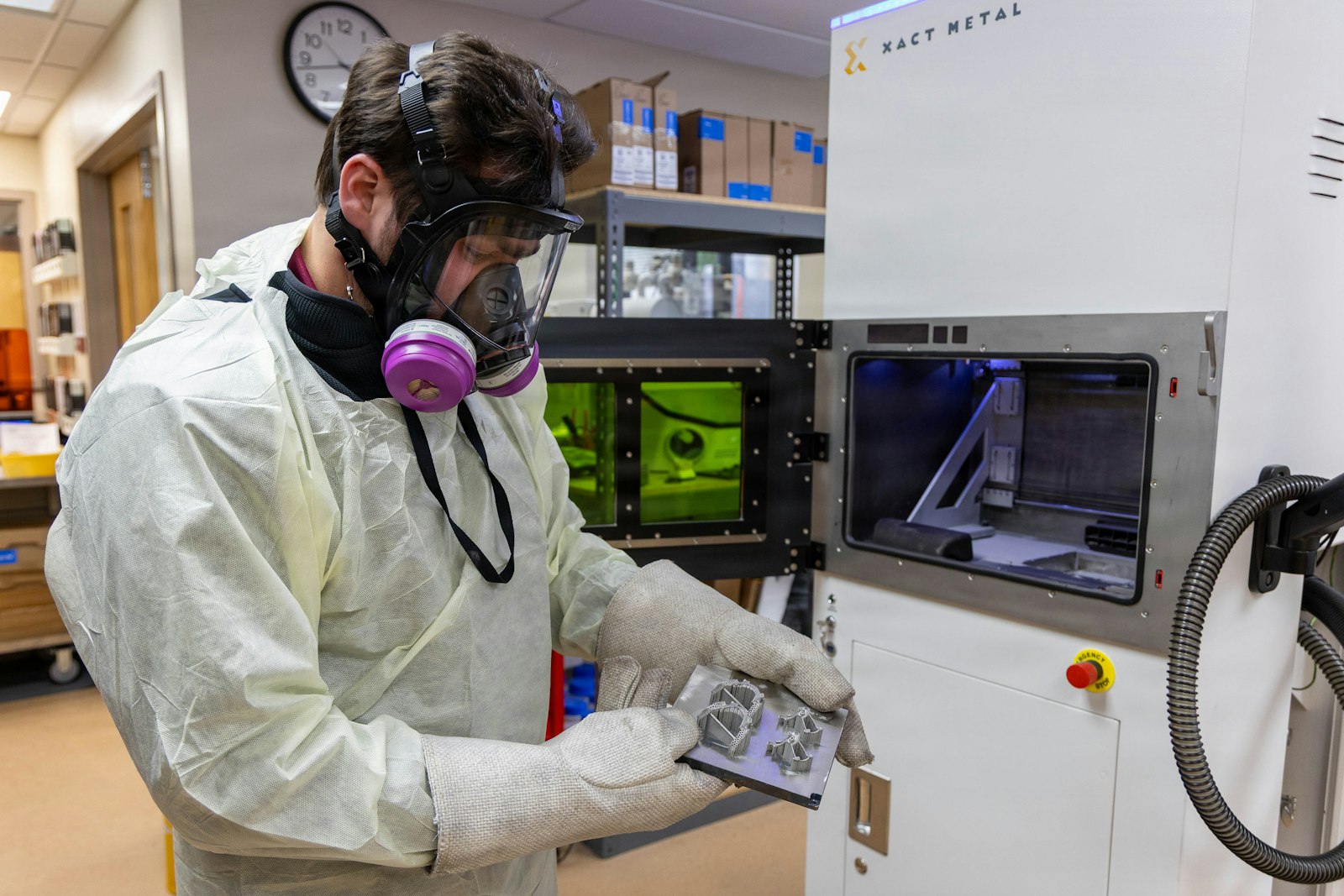
A high-power laser fuses fine metal powder layer by layer onto a build plate. The unfused powder around the part acts as support and is recycled after the build. After printing, the part is heat-treated to relieve stress, removed from the build plate via wire EDM, and any features that need tight tolerances are post-machined on CNC.
Common DMLS materials:
- AlSi10Mg — aluminum alloy, similar to A360 cast aluminum. Cheap and fast.
- Ti-6Al-4V — titanium grade 5. Most common aerospace and medical grade.
- Inconel 718 — nickel-based superalloy for high-temperature applications.
- 316L stainless steel — corrosion-resistant.
- Maraging steel (1.2709) — high-strength tool steel.
- CoCrMo — cobalt chrome, used in dental and orthopedic implants.
DMLS is fundamentally different from CNC in cost behavior — and that difference drives the entire economics.
Material waste: where DMLS structurally wins
CNC machining is subtractive — you start with a solid block and remove 50-90% of the material as chips. For aluminum parts, the chips can be recycled at low cost, so the waste matters less. For titanium, Inconel, and other high-cost alloys, the waste is a major driver of total part cost:

| Material | Bar stock cost ($/kg) | CNC waste ratio (typical) | Waste cost per part (1 kg net) |
|---|---|---|---|
| 6061-T6 | $5 | 70% | $11.70 |
| 316L stainless | $8 | 75% | $24.00 |
| Ti-6Al-4V | $80 | 80% | $320.00 |
| Inconel 718 | $120 | 80% | $480.00 |
| 17-4 PH stainless | $12 | 75% | $36.00 |
For a 1 kg titanium part, CNC waste alone costs $320 in scrap material — even if recycled, the recovery is 30-50% of bar-stock cost. DMLS waste is near-zero: unfused powder is recycled and re-used in the next build.
For Ti-6Al-4V and Inconel parts, DMLS material cost approaches CNC AFTER accounting for waste. For aluminum, the math doesn’t favor DMLS — aluminum is cheap, so even 80% waste isn’t expensive.
Complexity premium: DMLS stays flat, CNC explodes
CNC cost scales with complexity — every internal pocket, undercut, complex contour adds machining time. DMLS cost is almost flat with complexity because the printer prints whatever you tell it without additional setup time:
| Geometry | CNC cost (relative) | DMLS cost (relative) |
|---|---|---|
| Simple block | 1.0× | 1.0× |
| Pocketed bracket | 1.4× | 1.0× |
| Complex contour with undercuts | 2.5× | 1.0× |
| Internal cooling channels | 4.0× (often impossible) | 1.0× |
| Lattice structure | Impossible | 1.0× |
| Topology-optimized organic shape | Impossible | 1.0× |
The “DMLS = 1.0×” is the cost of the volume of material being printed, regardless of internal complexity. This is where DMLS becomes uniquely capable — internal cooling channels, conformal heat exchangers, lattice infill for weight reduction, and topology-optimized organic geometries are simply not machinable.
For these geometries, the question isn’t “DMLS or CNC?” — it’s “DMLS or this part doesn’t exist.”
The cost crossover formula
For aluminum (AlSi10Mg vs 6061-T6) — DMLS rarely beats CNC on absolute cost:
Crossover quantity = (DMLS total cost − CNC machining cost) ÷ CNC machining cost
>
Typical: DMLS aluminum is 3-5× CNC at all volumes. Use DMLS for aluminum only when complexity forces it.
For titanium and Inconel — DMLS beats CNC at production scale and complexity:
If part has internal cooling channels, lattice structure, or complex internal geometry → DMLS regardless of quantity
>
If part is a simple geometry → CNC always cheaper, even in titanium
For lightweighting (aerospace brackets, drone components):
DMLS topology-optimized version saves 30-50% of weight vs CNC subtractive version
>
Cost gap (~2-3× CNC) is justified by the per-flight fuel savings or per-mission payload gain
Four real customer cases

Case 1 — Aerospace bracket (Ti-6Al-4V, qty 50)
- CNC version: 2.4 kg billet → 0.6 kg part. Material cost $192, machining $480/piece. Total: $672/piece × 50 = $33,600.
- DMLS version: 0.6 kg part directly printed with topology optimization, additional 30% weight removed via lattice. Final part 0.42 kg. Material cost $34, print + post-processing $580/piece. Total: $614/piece × 50 = $30,700.
- Verdict: DMLS wins by $2,900 AND the part is 30% lighter. Decision was easy.
Case 2 — Drone landing gear (AlSi10Mg, qty 200)
- CNC version: $35/piece in 6061-T6, conventional design. Total $7,000.
- DMLS version: $95/piece, even with topology optimization. Total $19,000.
- Verdict: CNC wins by 2.7×. Weight savings on aluminum drone parts (10-15g savings) didn’t justify the cost premium.
Case 3 — Conformal cooling injection mold core (Maraging steel, qty 1)
- CNC + EDM version: $12K for the mold core machined with straight-line cooling channels. Cycle time on the resulting molded part: 35 seconds.
- DMLS version: $18K for the same core printed with conformal cooling channels following the part contour. Cycle time on molded parts: 22 seconds — 37% faster.
- Verdict: DMLS wins despite higher core cost — the 37% cycle-time reduction recovered the $6K premium in the first 2 weeks of production.
Case 4 — Custom medical implant (CoCrMo, qty 1)
- CNC version: Not viable. The part has patient-specific anatomical contours that can’t be reached with a 5-axis cutter.
- DMLS version: $1,800/piece, anatomically conformed.
- Verdict: DMLS only. CNC isn’t an option for patient-specific implants.
Post-processing: the cost everyone forgets
A “DMLS part” is rarely shipped as-printed. Standard post-processing:
| Step | Time | Cost (typical) |
|---|---|---|
| Stress relief heat treatment | 6-12 hours | $50-150/build |
| Build plate removal (wire EDM) | 2-4 hours | $80-200/part |
| Support structure removal | 30-90 min/part | $30-100/part |
| Surface bead-blasting | 15-30 min/part | $20-50/part |
| CNC post-machining critical features | 1-3 hours/part | $80-300/part |
| Heat treatment (HIP for aerospace/medical) | 4-8 hours | $200-500/build |
| Final inspection (CMM) | 30-60 min/part | $40-100/part |
A part listed at “$400 DMLS” can become $700-900 fully delivered after post-processing. CNC quotes typically include all features in one number — comparing apples-to-apples requires fully-loaded delivered cost on both sides.
DMLS material strength vs wrought equivalent
DMLS parts are NOT identical to wrought / forged equivalents — they have different mechanical properties due to the layer-fused microstructure:
| Property | Wrought Ti-6Al-4V | DMLS Ti-6Al-4V (as-printed) | DMLS Ti-6Al-4V (HIP’d) |
|---|---|---|---|
| Tensile strength (MPa) | 950 | 1,100-1,200 | 950-1,000 |
| Yield strength (MPa) | 880 | 1,050-1,150 | 880-950 |
| Elongation (%) | 14 | 8-12 | 12-15 |
| Fatigue strength | Good | Lower (porosity) | Equivalent to wrought |
DMLS-as-printed is stronger but more brittle. After HIP treatment (Hot Isostatic Pressing — applies pressure + heat to close internal voids), DMLS parts have mechanical properties equivalent to wrought. For aerospace and medical use, HIP is non-negotiable. For non-critical use, as-printed is acceptable but document the limitation.
Decision tree
Walk through these in order — first match wins:
- Part has internal cooling channels, lattice infill, or topology-optimized organic shape? → DMLS only.
- Material is titanium / Inconel / CoCrMo AND quantity is low? → DMLS likely cheaper after waste calculation.
- Material is aluminum (any alloy)? → CNC almost always wins on cost. Use DMLS only if geometry forces it.
- Material is steel and geometry is simple? → CNC.
- Need conformal cooling in tooling? → DMLS for the core, traditional machining for the rest of the mold.
- Patient-specific or one-off custom geometry? → DMLS.
- Quantity > 100 simple parts in any material? → CNC, almost always.
FAQ
Why is DMLS so expensive in absolute terms?
Three factors: (1) machine cost — a metal 3D printer costs $300K-1.5M, so machine-hour rate is $80-200/hr vs CNC at $50-120/hr. (2) Build time is slow — 2-3 mm/hr vertical build rate, meaning a 100mm tall part takes 30-50 hours. (3) Post-processing adds 30-50% to the as-printed cost. The combination puts DMLS at 5-15× CNC for simple geometries; complexity narrows the gap dramatically.
Can DMLS replace CNC entirely for aerospace?
Selectively. Topology-optimized brackets, lightweight structural components, fuel system parts with complex internal geometry — yes. Standard aerospace fasteners, simple machined housings, structural hard-points — CNC is still cheaper and faster. Most aerospace programs use both: DMLS for the parts that benefit from additive, CNC for everything else.
What’s the smallest DMLS feature I can print?
Typically 0.4 mm minimum wall, 0.4 mm minimum hole, with practical reliability at 0.5 mm and above. Internal channels can go as small as 0.4 mm but require careful design to allow powder removal. Below 0.4 mm, surface roughness consumes the feature. For comparison, CNC can hold ±0.025 mm on features down to ~0.5 mm reliably with proper tooling.
Does DMLS need design changes vs CNC?
Yes — significant. Wall thickness, draft (down-facing surfaces), support requirements, and orientation all change between processes. A part designed for CNC then sent to DMLS without revision usually has higher material cost (excess walls), worse surface finish (orientation issues), and longer print time (poor support strategy). For best results, redesign with DMLS-specific guidelines using topology optimization and DfAM (Design for Additive Manufacturing) principles. We cover this in our 3D printing capabilities page.
Are DMLS parts watertight / pressure-tight?
As-printed DMLS parts have 0.1-1% internal porosity — small voids between fused layers. For pressure-tight applications (hydraulics, high-pressure gas), the part must be HIP’d to close the porosity. Thin-walled tubes (under 1 mm wall) are particularly risky for leaks even after HIP — for those, brazing a CNC-machined sleeve over the printed part is sometimes the right answer.
Get a quote in 24 hours
Send your STEP / DWG file — engineer-direct reply with DFM included.
Leave a Reply