
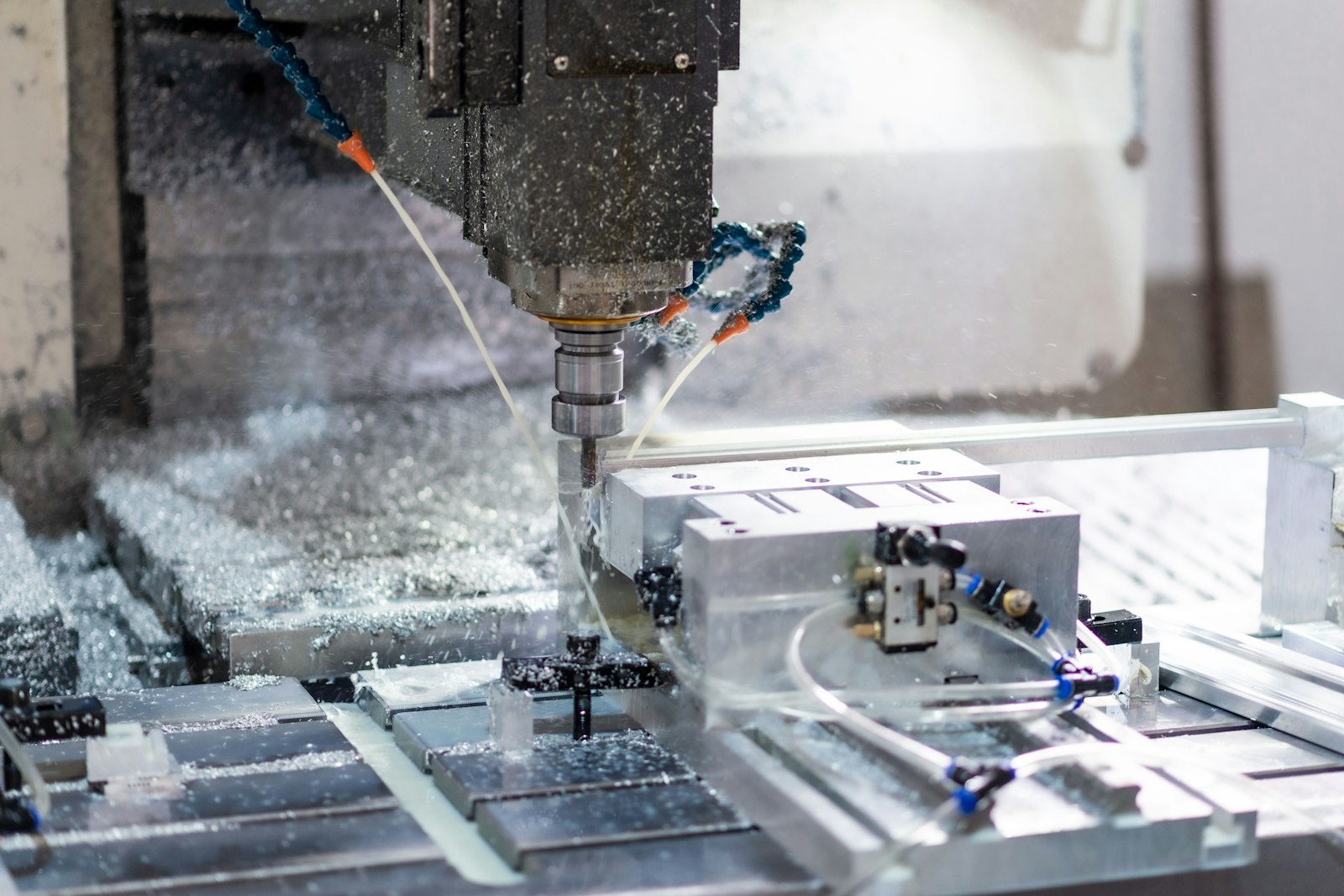
Why design choices drive 60% of CNC cost
Most engineers think CNC cost is set by material and quantity. In reality, the geometry decisions you make in the first hour of CAD work drive 60% of the final invoice. A part that’s perfectly functional can be 30-50% cheaper to make if you follow a handful of design rules — without changing strength, fit or appearance.
This guide is the cheat sheet our process engineers wish they could send with every RFQ. Seven rules, each backed by what actually happens on the shop floor when the rule is broken.
1. Avoid deep, narrow pockets
The cheapest pocket geometry is wide and shallow. The most expensive is narrow and deep. The moment your aspect ratio (depth ÷ width) exceeds 4:1, every detail of machining gets harder:
- The cutter has to be slender, which makes it deflect and chatter.
- The tool has to be longer than the pocket depth, reducing rigidity further.
- Chip evacuation fails — chips re-cut and ruin the surface, requiring slower feeds.
- Inspection becomes guesswork because you can’t reach the bottom with a touch probe.
Rule: Keep pocket depth ≤ 4× the pocket’s narrowest internal dimension. If your design needs 30 mm deep pocket, the narrowest section should be ≥ 7-8 mm wide.
Workarounds when you must go deeper:
- Split the part into two pieces and bond/screw them together.
- Add a side window (slot through one wall) so a different tool can reach in horizontally.
- Move to a 5-axis machine (cuts the deep cavity at an angle, allowing a shorter cutter — see our 3-axis vs 5-axis comparison).
2. Use generous internal corner radii
A sharp internal corner is impossible to mill — the cutter is round. To get a perfectly square corner, the shop has to switch from milling to EDM (electrical discharge machining), which adds $300-1000 per corner and 1-3 days to lead time.
The fix is trivial: spec a corner radius equal to or larger than 1/3 of the deepest pocket depth. For a 15 mm deep pocket, a 5 mm corner radius lets a 10 mm endmill clear the corner in a single pass — fast, cheap, no EDM needed.
Rule:
| Pocket depth | Minimum corner radius | Recommended cutter dia. |
|---|---|---|
| Up to 6 mm | 2 mm | 3-4 mm |
| 6-12 mm | 3 mm | 5-6 mm |
| 12-25 mm | 5 mm | 8-10 mm |
| 25-50 mm | 8 mm | 12-16 mm |
The trap: designers add a tiny 1 mm corner radius “to keep it manufacturable” without realizing that anything smaller than 3 mm forces a slow, deflection-prone finishing pass with a tiny cutter that costs 3× the finish time.
3. Hold realistic wall thickness
Walls thinner than 0.8 mm in metal (1.5 mm in plastic) tend to flex during cutting, causing chatter and dimensional inconsistency. Walls thicker than they need to be waste material and machining time.
Rule: Aim for walls between 1 and 4 mm for most CNC parts. If you need a thinner wall, consider:
- Switching to sheet metal fabrication (designed for thin walls)
- Adding ribs to stiffen the wall during machining (machine away the ribs as a final finishing pass — yes, this works)
- Switching from 6061-T6 to 7075-T6 (stiffer, allows thinner walls without flex — see 6061 vs 7075)
4. Standardize hole sizes
Every unique hole diameter on your part = another tool change, another tool inventory line item, another setup risk. The cheapest part has 3-4 hole sizes. The most expensive has 14 unique sizes — half of which are non-standard custom drills.

Rule: Stick to standard imperial or metric drill sizes. Tap sizes especially — use M3, M4, M5, M6, M8, M10 for almost all fastener applications. Avoid M3.5, M4.5, M7, etc., which require special tools.
Common mistake: a designer specifies a 4.7 mm hole because it gives the perfect interference fit calculation. The shop has to either (a) pay for a custom drill, or (b) drill 4.5 mm and ream to 4.7 mm, doubling the time per hole. A 4.5 mm hole with a 0.05 mm undersize sleeve insert achieves the same fit at 1/3 the cost.
5. Tight tolerances cost real money
Default mechanical tolerance (ISO 2768 medium) is roughly ±0.1 mm — and it’s free to achieve on a modern CNC. Tighter tolerances force slower cutting speeds, post-machining inspection, additional finishing passes, and sometimes hand-fitting:

| Tolerance | Cost multiplier | Common use |
|---|---|---|
| ±0.5 mm | 0.7× | General brackets, decorative |
| ±0.1 mm (ISO 2768-m) | 1.0× (baseline) | Most engineering parts |
| ±0.05 mm | 1.3× | Press-fit features, bearing seats |
| ±0.025 mm | 1.8× | Hydraulic fits, indexing surfaces |
| ±0.01 mm | 2.5-4× | Aerospace, medical, jig and fixture |
Rule: Apply tight tolerances only to features that actually need them. The base block can be ±0.1 mm; the bearing bore needs ±0.025 mm. On the drawing, mark the toleranced dimensions clearly and let everything else default to ±0.1 mm.
Trap: a designer applies a global ±0.025 mm “to be safe” and quadruples the inspection time on every face of the part. Be specific — tight tolerances are an explicit decision, not a default.
6. Design for fixturing
Every CNC operation requires the part to be held still. The fixturing strategy is decided before any cutting happens, and it drives setup count, accumulated error and cycle time.
Workholding-friendly geometry:
- At least two parallel flat faces for a vise to grip — even if only one is functional.
- A flat datum face on the bottom (or one side) the operator can clamp from.
- No critical features near the clamping zone — the clamp may distort the part if it’s thin-walled there.
- Symmetric workpieces let the shop machine multiple at once on a tombstone fixture (4-up, 6-up).
The expensive case: a part with no flat face whatsoever requires a soft jaw (custom-cut vise jaw machined to fit the part shape) which adds $200-500 setup cost per batch and 1 day of lead time. For a 5-piece prototype run, the soft-jaw cost can equal the part cost.
Easy win: leave a 5 × 50 mm flat “sacrificial” pad on one face that you cut off in a second operation. The pad gives the vise a clean grip surface for the first 90% of machining, then disappears on the final op.
7. Don’t over-specify surface finish
A standard CNC-machined finish is roughly Ra 1.6 µm (32 µin) — no extra cost. Tighter finishes require slower finish passes, smaller stepovers, more polishing. Loose finishes are free but rarely useful.
| Surface finish (Ra) | Cost vs default | Achieved how |
|---|---|---|
| 6.3 µm (250 µin) | 0.8× | Roughing only, no finish pass |
| 3.2 µm (125 µin) | 0.95× | Single light finish pass |
| 1.6 µm (63 µin) | 1.0× — default | Standard finish pass |
| 0.8 µm (32 µin) | 1.4× | Slow finish, smaller stepover |
| 0.4 µm (16 µin) | 2.2× | Very slow finish or grind |
| 0.1 µm (4 µin) | 5×+ | Polishing or lapping |
Rule: Spec Ra 1.6 µm as the default for all faces. Apply tighter finish only to specific faces that need it (sealing surfaces, sliding bearings, optical mating). Anodizing or powder coating hides Ra 3.2 µm completely — over-finishing parts that are getting surface treatment is just paying twice.
The cost-saving recap
These 7 rules together typically reduce CNC machining cost by 30-50% on a part that started “by-the-book” without DFM:
- Pocket aspect ratio ≤ 4:1
- Internal corner radius scaled to pocket depth
- Wall thickness 1-4 mm (use ribs for thinner walls)
- Hole sizes from standard sets only
- Tight tolerances only where functional, default ±0.1 mm
- At least two parallel flat clamping surfaces
- Default Ra 1.6 µm, tighter only when necessary
The big win comes from applying all seven. Each individually saves 5-10%; together, the multiplier on cycle time is what produces the 30-50% range. Run the checklist before you send the file. If you’d like our process engineers to run it for you, the DFM review is part of every CNC quote at zero extra cost.
FAQ
Which rule has the biggest cost impact?
Tolerance specification — typically the largest single driver. A part designed with everything at ±0.1 mm except 3 specific bearing surfaces at ±0.025 mm costs 1.0-1.1×. The same part with a global ±0.025 mm callout costs 1.8-2.0×. That’s a 70-80% cost difference from a single drawing convention.
How do I know if a corner radius is too small without trial-and-error?
Use this rule: minimum internal corner radius = (pocket depth ÷ 4) for 3-axis CNC. For a 20 mm deep pocket, you want at least 5 mm radius. If you can’t fit a 5 mm radius, you should either redesign the pocket shape, switch to 5-axis machining, or accept EDM cost. The CAD model’s “minimum internal radius” analysis tool flags every spot under your threshold automatically.
Are these rules different for 5-axis CNC?
Slightly relaxed. 5-axis machines tilt the workpiece, so deep pockets with steep walls become accessible from the side — pocket aspect ratio can go to 6:1 instead of 4:1. Internal corner radii can be smaller because shorter, stiffer cutters reach further in. Wall thickness and tolerance rules don’t change. Surface finish is actually easier on 5-axis because the cutter approaches faces perpendicularly. See the 3-axis vs 5-axis comparison for detailed tradeoffs.
Does material affect these rules?
Yes — materials like 6061 aluminum are forgiving (chatter is rare, finish is easy), so you can push closer to the limits. Stainless 316L and titanium are tough on tools and reduce safe limits by ~20-30%: thinner walls chatter, tighter corners cause tool breakage. Always tell your machinist what material before they quote — the same geometry costs 1.5× more in titanium than 6061. Browse our materials library for material-specific notes.
What’s the single best DFM check I can run?
Open your CAD file, hide all faces, then unhide one face at a time. Every face that requires the part to be re-fixtured to reach is an extra setup ($75-150 per setup). If you have more than 2 setups, look for ways to consolidate features into a single side. This one check alone catches 50%+ of DFM cost waste in our experience.
Get a quote in 24 hours
Send your STEP / DWG file — engineer-direct reply with DFM included.




Leave a Reply