Quick verdict
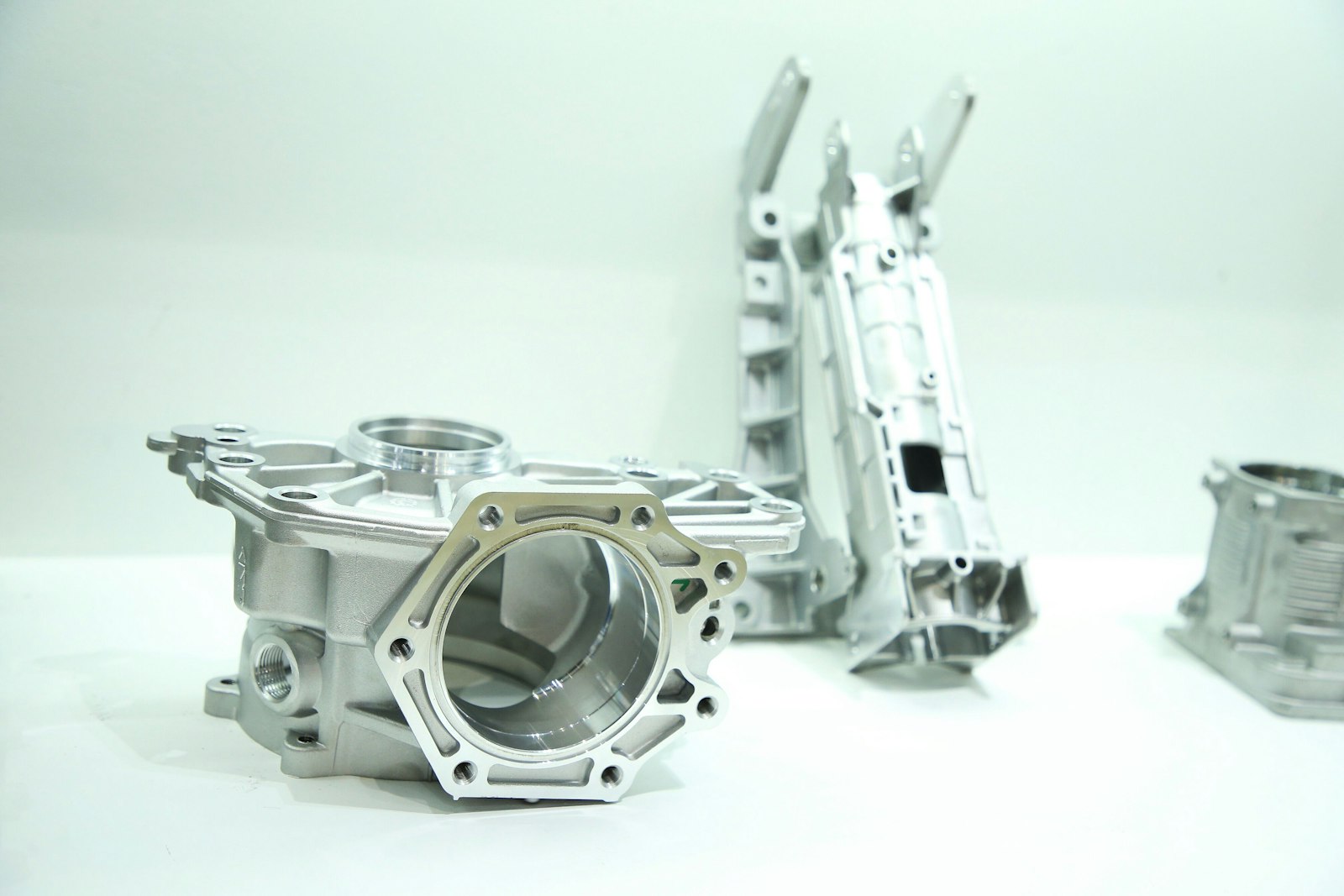
The decision between die casting and CNC machining for aluminum housings comes down to one number: annual quantity.
- Below 500 pieces/year → CNC machining always wins. Tooling investment for die casting can’t be recovered.
- 500-2,000 pieces/year → Either can work. Other factors (geometry, surface finish, time-to-market) decide.
- Above 2,000 pieces/year → Die casting wins decisively, often by 5-10× per piece.
The trickier question is “when else?” — when geometry, finish, or strength forces one process over the other regardless of quantity.
How the two processes compare
| Aspect | Die casting (HPDC) | CNC machining |
|---|---|---|
| Tooling investment | $15K-50K (steel mold) | $0-2K (programming + fixtures) |
| Per-piece cost (1,000 pcs) | $4-12 | $40-80 |
| Per-piece cost (100 pcs) | $25-60 (amortized tooling) | $40-80 |
| Lead time to first piece | 6-10 weeks | 5-10 days |
| Geometry complexity | Excellent — thin walls, ribs, undercuts | Good — but expensive for complex 3D |
| Internal pockets / hollow | Built into casting | Adds cost (long cutter paths) |
| Tolerance (as-produced) | ±0.1-0.3 mm | ±0.005-0.05 mm |
| Surface finish (Ra, as-cast) | 1.6-3.2 µm | 0.8-1.6 µm |
| Material strength | ADC12: 240 MPa tensile | 6061-T6: 310 MPa tensile |
| Material wastage | Near-zero (cast to net shape) | 50-80% (subtractive) |
| Min order quantity | 500-1,000 pcs (economic) | 1 piece |
The headline gap: die casting has high upfront cost (mold) and very low per-piece cost; CNC has zero upfront cost and roughly flat per-piece cost. The crossover happens around 500-1,000 pieces depending on part complexity and tooling investment.
Tooling investment and amortization
A typical aluminum die-cast mold runs $15K-50K. The price is driven by:

- Cavity count (single-cavity = cheaper, multi-cavity = faster cycle)
- Part size (a 200×200 mm part needs a much bigger mold than 50×50 mm)
- Complexity (slides, lifters, hot-runner systems each add cost)
- Steel grade (ADC12 cast in P20 lasts 200K shots; H13 lasts 1M+)
- Surface finish requirements on the part (mirror polish on cosmetic faces adds tooling cost)
To break even on $30K of tooling at $50/piece CNC vs $7/piece die-cast (saving $43/piece):
$30,000 ÷ $43 = 697 pieces breakeven
Below that quantity, CNC wins on absolute cost. Above 700+ pieces, die casting starts saving real money. The breakeven shifts depending on tooling complexity and per-piece cost gap.
Important: tooling cost is a sunk investment — you pay it once, but it doesn’t depreciate to zero. If your annual quantity is 5,000+ for 5+ years, the tooling cost spreads over 25,000+ pieces. That changes the math dramatically: $30K spread over 25K pieces is $1.20/piece amortized — practically free.
Post-cast machining: the hidden cost
A “die-cast” aluminum part rarely ships as-cast. After casting, most parts need:
- Sprue / runner trimming: $0.50-2 per piece
- Flash removal (deburring): $0.50-3 per piece
- CNC machining of critical features: $5-30 per piece (mating surfaces, threaded holes, sealing flanges)
- Surface finishing (deburring + bead-blasting + anodize/paint): $2-10 per piece
A part listed at “$8 die-cast” can easily become $15-30 delivered once secondary operations are factored in. CNC quotes usually include all features in a single number — die casting quotes often split out the casting cost from secondary operations, and the as-cast number is misleading.
Always ask for fully-loaded delivered cost, not just casting cost.
Surface finish and appearance
As-cast aluminum surfaces have:
- Visible parting lines (where the two mold halves meet) — typically a fine ridge that needs to be deburred or machined off
- Mold release residue and oxide layer (cleaning required before paint or anodize)
- Slight variations in surface texture between cycles
- Ejector pin marks (small circular impressions, typically on B-surfaces)
After secondary operations (deburring + media blasting + anodize), die-cast and CNC parts can look identical. The cost difference for premium cosmetic finish:
- Bead-blasted + anodize on CNC: $3-6/piece
- Bead-blasted + anodize on die-cast: $5-10/piece (more aggressive cleanup needed)
For aerospace, defense, or premium consumer products with cosmetic-grade requirements, CNC has a slight edge in the as-shipped finish quality. For automotive, industrial, household appliance — die-cast finishes are equivalent after standard secondary ops.
Strength differences
This catches engineers off-guard. CNC-machined 6061-T6 is roughly 30-50% stronger than ADC12 die-cast aluminum:
| Property | ADC12 (die-cast) | 6061-T6 (CNC) | A356-T6 (sand cast) |
|---|---|---|---|
| Tensile strength (MPa) | 240 | 310 | 290 |
| Yield strength (MPa) | 130 | 276 | 200 |
| Elongation (%) | 1.5 | 12 | 6 |
| Density (g/cm³) | 2.74 | 2.70 | 2.68 |
| Thermal conductivity (W/m·K) | 92 | 167 | 155 |
Two consequences:
1. Die-cast parts need 20-30% more material to achieve the same load-bearing capacity as 6061-T6 machined parts. That eats into the cost advantage in size-constrained applications. 2. Thermal conductivity is much lower for ADC12 — for heatsinks and thermal management housings, CNC 6061 wins regardless of quantity.
If your part is structural or thermal, CNC may be the right pick even at production volumes. ADC12 is fine for non-load-bearing covers, brackets, and cosmetic enclosures.
Four real customer cases

Case 1 — IoT sensor housing (annual: 50,000 pcs)
- Geometry: 80×60×30 mm, ribbed exterior, 3 mounting bosses, IP65 sealed lid
- Verdict: die casting, $4.20/piece delivered with finishing. CNC same part: $35/piece. Tooling investment $22K paid back in 2,500 pieces.
Case 2 — Drone gimbal frame (annual: 800 pcs)
- Geometry: 120×80×40 mm, 5-axis machined features, ±0.02 mm bearing bores, structural load
- Verdict: CNC machining, $48/piece. Die casting unviable — too small a quantity to amortize $35K mold, AND the 6061-T6 mechanical properties are required for structural loading.
Case 3 — Heatsink housing for industrial laser (annual: 1,200 pcs)
- Geometry: 200×150×60 mm, dense fin array, thermal management critical
- Verdict: CNC machining, $85/piece. Despite production-volume quantity, the 1.8× thermal conductivity of 6061 vs ADC12 made the 2× cost worthwhile — laser ran hotter on cast version, eventually de-rated to 80% capacity.
Case 4 — Consumer kitchen appliance enclosure (annual: 25,000 pcs)
- Geometry: 350×250×200 mm, complex curved surfaces, integrated cooling vents, painted finish
- Verdict: die casting, $9.80/piece delivered. CNC same part: $120/piece. Tooling investment $42K paid back in <500 pieces. Painted finish hides cast surface texture entirely.
Decision tree
Walk through these in order — first match wins:
- Annual quantity < 500 pcs? → CNC machining
- Need ±0.02 mm tolerances on bearing/sealing surfaces? → CNC, OR die-cast + post-machine the critical features
- Structural part needing 6061-T6 strength? → CNC
- Heatsink or thermal management role? → CNC (for 6061-T6 thermal conductivity)
- Annual quantity > 2,000 pcs and non-structural? → Die casting
- Need complex internal hollow geometry? → Die casting
- Time-to-market < 4 weeks? → CNC (die casting tooling alone takes 6-10 weeks)
- Otherwise → Run breakeven analysis: at quoted per-piece cost gap and your tooling investment, calculate the breakeven quantity and decide
FAQ
Can die-cast parts be machined for tighter tolerances?
Yes — and most production die-cast parts ARE post-machined for critical features. A typical workflow: cast the rough geometry, then CNC the bearing seats, sealing flanges and threaded holes to ±0.025 mm. Combined process gives die-casting cost on the bulk of the part with CNC tolerance where needed.
What’s the smallest run economical for die casting?
Practically 500-1,000 pieces — below that, the per-piece amortized tooling cost exceeds CNC pricing. There are workarounds: rapid prototype molds (lower-grade tool steel, $8-15K, 5K-shot life) bring breakeven down to ~250 pieces. Vacuum casting in silicone molds covers 1-50 pieces but at $40-60/piece — closer to CNC pricing for that volume. See casting services for the full range.
Why is ADC12 weaker than 6061-T6?
ADC12 is a casting alloy designed for fluidity in the casting process — high silicon content (~10%) makes it flow into thin sections. 6061-T6 is a wrought alloy heat-treated after rolling/extrusion to achieve maximum strength. The casting structure has microscopic porosity and grain boundaries that limit strength; the wrought-and-aged structure of 6061 has none. For high-strength casting, A356-T6 (heat-treated cast) closes some of the gap but at a 1.5× cost premium over ADC12.
Can I use 6061 for die casting?
No — 6061 is a wrought alloy, not a casting alloy. The closest cast equivalent that offers similar mechanical properties is A356-T6 or 535.0. Both cost more per kg than ADC12 and require longer cycle times.
How long does die-cast tooling last?
A standard ADC12 mold made in P20 steel lasts 100,000-300,000 shots before requiring polishing or repair. H13 hardened mold steel lasts 500,000-1,000,000 shots. For very high volume (millions/year over multiple years), invest in H13 — the per-piece tooling cost drops to fractions of a cent. For lower volume (10K-100K/year), P20 is sufficient and cheaper to make.
Get a quote in 24 hours
Send your STEP / DWG file — engineer-direct reply with DFM included.
Leave a Reply